Let’s Talk About Anxiety

February 25, 2016 by Deborah Penner


Dear Dr. Penner,
“My older son suffers from debilitating anxiety that often leads to panic attacks. He believes he just has to live with it, but I was wondering if whole food medicine can help with this?”

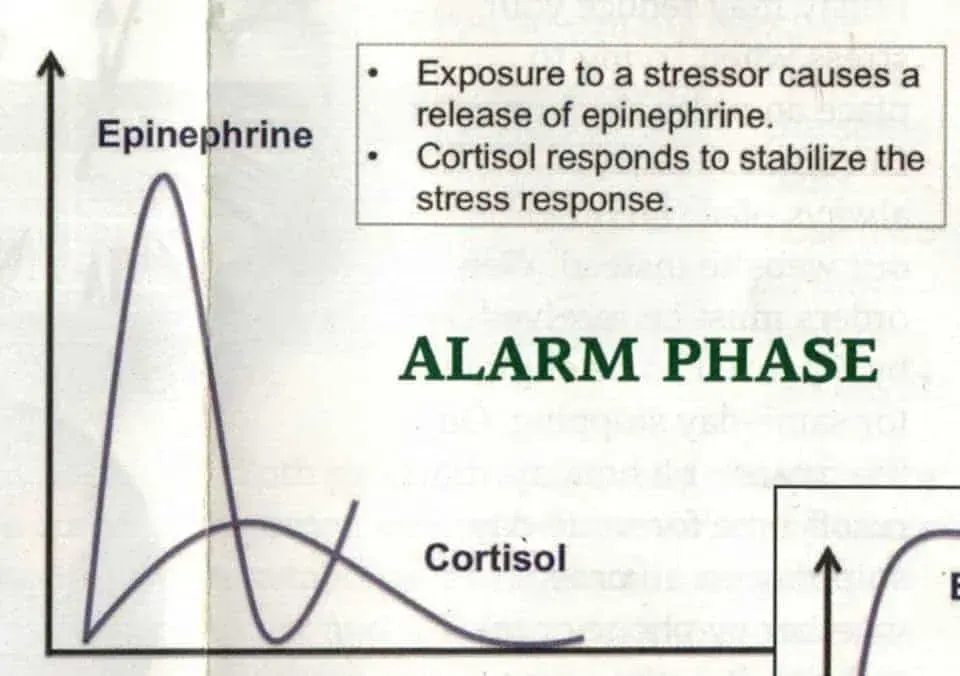
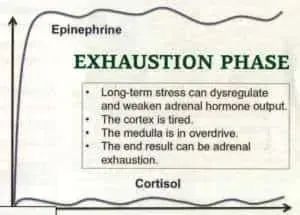
Adrenal Fatigue diagram

This is a topic close to my heart. When I was 33 I was starting my first practice in San Diego, commuting an hour each direction on a 4-lane, high speed free-way to work 6 days a week, fueling myself with caffeine, and struggling to make ends meet. About 2 ½ years into this rat-race, I had a panic attack!!!


I recall waking up at 3 AM one morning with my heart racing at over 200 beats per minute, my arms and legs completely numb, shaking like a leaf in a windstorm. If I didn’t have the medical back ground to recognize what I was experiencing (which took a few minutes) I would have thought I was dying and started hollering for help. As it was, I laid there long enough to sort out what was going on and eventually was able to crawl over to the wall heater with a blanket, where I laid in fetal position for hours until the feeling came back into my extremities, my heart slowed down a bit, and I could make it to the phone to call my office and tell them I wasn’t coming in that day.


Panic attacks are a big red flag that your sympathetic (fight/flight) nervous system is over stimulated. Often, this over stimulation is due to circumstantial things like relational troubles, financial stress, or trauma. Other times, the nervous system is responding to inflammation caused by foods, drugs, toxic environmental factors, or microbial infections.


Regardless of the initiating factors, if your nervous system is under too much stress for too long, things start to devolve into brain agitation and adrenal exhaustion.


Your adrenal glands are your stress handlers. They are under the direction of your higher brain centers, the hypothalamus and pituitary. Together, they are known as the HPA axis. When you are under any kind of stress, the hypothalamus and pituitary release hormones that trigger the adrenals to produce the stress hormones adrenalin and cortisol which turn on the “fight-flight” nervous system to manage the situation.


While cortisol initially acts as an anti-inflammatory, it is a “catabolic” hormone which means that over time it causes tissue break down. When stress is prolonged, tissue break down becomes profound. Tissue breakdown means increased inflammation. Increased inflammation means increased infection potential, and eventually disease.


The first tissues to break down are the delicate ones; brain, gut, lungs. This leads to problems such as; anxiety/panic attacks, ADD, brain-fog, asthma, bronchitis, gastritis, leaky gut syndrome, IBS, allergies, and on and on.


These diagrams show in very simple terms what happens physiologically with your stress hormones as adrenal fatigue and exhaustion set in.
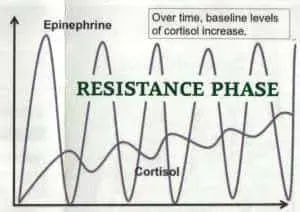
What can you do about this? A lot!


Take the new Standard Process Stress Assess questionnaire (click here) for starters. If a more in depth evaluation is indicated, we can order a saliva test to assess the circadian output of cortisol during the waking hours.

Seyle’s Adrenal Fatigue

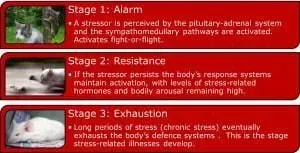
Seyle’s General Adatpion

Seyle’s Adrenal Fatigue

In this crazy day and age virtually everyone is dealing with some level of  brain/HPA axis agitation aka “stress!”


Fortunately, there are some wonderful whole food medicine protocols that really help!


Optimizing your energy pathway is a primary objective to reduce adrenal stress, lower inflammation, and settle down the brain.


Liver/gall-bladder detox is often indicated in that the liver has over 500 bodily functions including inflammation control, carbohydrate, protein, and fat metabolism, and hormone balance.


Since tissue breakdown and inflammation throws open the door for microbial infection, microbial management becomes important for many people. This involves utilizing herbs and whole foods to improve immune function and discourage microbial proliferation.


And lastly, but certainly not least, calming support for the poor HPA axis! While adequate sleep and stress management strategies are important, there are wonderful herbs and whole food medicines that help, too.


My favorites include Neuroplex (Standard Process) and  Medi-Herb’s Kava Forte for hypothalamus-pituitary  support. SP Drenamin & MH Adrenal Complex for adrenal support. All available through my office.


Don’t let anxiety eat you alive!


I look forward to hearing from you!

Sincerely,

Dr. Penner

Watercolor-style cows grazing in a green pasture under a bright sky
By Deborah Penner June 25, 2025
March 25, 2025 by Deborah Penner In a world full of modern seed oils and synthetic skincare products, tallow is making a comeback—and for good reason. In his latest article, Dr. Robert Malone explores this time-honored fat that has nourished and supported humans for generations. From its dense nutritional profile to its unique benefits for the skin, tallow stands out as a versatile, shelf-stable, and highly bioavailable source of essential fatty acids, fat-soluble vitamins (A, D, E, K2, and B12), and anti-inflammatory compounds like conjugated linoleic acid (CLA). Dr. Malone breaks down what tallow is, how it’s rendered, and why sourcing it from grass-fed animals matters. He covers its historical culinary use, superior storage potential, and modern skincare advantages. He also shares how to make tallow at home, along with tips for storage, sourcing, and practical applications—even including a nod to traditional meat drippings. If you’re interested in ancestral nutrition, reducing toxic exposures, or reclaiming sustainable practices in your home and kitchen, this article is a must-read.  Read the full article on Robert Malone’s website to explore the health benefits, uses, and how-to of tallow.
Plated roasted lamb chop with herbs, berries, and lemon slices on a white dish
By Deborah Penner March 20, 2025
March 20, 2025 by Deborah Penner If you’re looking for a powerful way to support metabolism, joint health, and overall vitality—without reaching for another supplement—consider this often-overlooked cut of meat: the shank. In a recent article on Mercola, Ashley Armstrong highlights why shanks (from beef, pork, or lamb) may actually outperform steaks when it comes to nutrient density and health benefits. Rich in collagen and connective tissue, shanks offer a more balanced amino acid profile than typical muscle meats. When cooked low and slow, they yield gelatin—a form of collagen that’s easier for the body to absorb. This provides crucial support for the skin, joints, bones, and gut, while also boosting metabolic health through glycine, a key amino acid that helps regulate inflammation and energy production. Armstrong also explores the wisdom of traditional diets, which prioritized nose-to-tail eating and naturally included more collagen-rich foods. Today’s steak-heavy habits miss out on these benefits, making shanks an easy and affordable way to restore that balance. The article includes 15 time-tested recipes from around the world, and a video walking through Armstrong’s favorite braising method.
Silhouetted figure facing a vivid watercolor sky with a cell tower and power lines at sunset
By Deborah Penner March 17, 2025
March 17, 2025 by Deborah Penner Electromagnetic fields (EMF) and 5G technology have rapidly expanded across the globe with little consideration for their long-term impact on human health and the environment. Dr. Mark Trozzi, a dedicated physician and researcher, explores the hidden dangers of EMF exposure and the heightened risks that come with 5G. He reveals how governmental agencies, despite being informed of the concerns, have remained powerless in the face of telecom industry influence. Even before the rollout of 5G, studies linked EMF exposure to a range of serious health issues, including cancer, infertility, neurological disorders, and cardiovascular disease. Dr. Trozzi highlights that 5G takes these risks further with the use of higher frequencies, such as 60 GHz, which directly interact with oxygen molecules and could disrupt their ability to bind with hemoglobin. He also sheds light on the military origins of some 5G frequencies and the aggressive destruction of trees to facilitate stronger signals—an alarming environmental consequence. Through his research, Dr. Trozzi underscores the urgent need to recognize EMF radiation as a major public health threat. He calls for awareness, education, and practical steps to mitigate exposure, drawing attention to the work of leading experts like Dr. Devra Davis and Dr. Arthur Firstenberg. To learn more about the critical health risks of 5G and EMF exposure, read the full article and watch the video at drtrozzi.news .
Person crouching in a grassy field beside a vivid blue, orange, and pink fire-like landscape
By Deborah Penner March 11, 2025
March 11, 2025 by Deborah Penner Wildfire smoke exposure has profound health consequences, yet its impact on chronic illness remains widely overlooked. A Midwestern Doctor explores the link between particulate matter inhalation and conditions such as cardiovascular disease, lung disease, and cognitive decline, emphasizing the role of glutathione in protecting lung tissue. The article highlights the lessons learned from wildfire-related illnesses, particularly how exposure worsens pre-existing inflammatory conditions and contributes to long-term health deterioration. It also sheds light on the parallels between wildfire toxicity and other environmental exposures, such as pollution and pharmaceuticals, that can push individuals past their body’s threshold for chronic illness. One of the most promising solutions discussed is nebulized glutathione, which replenishes the lungs’ natural defense system, helping mitigate damage from smoke inhalation and potentially offering relief for those suffering from COPD. Additionally, the therapeutic potential of DMSO in respiratory conditions is examined, alongside other integrative approaches for addressing the systemic effects of wildfire exposure. To understand how wildfire illness can reshape our approach to lung health and chronic disease, read the full article by A Midwestern Doctor on The Forgotten Side of Medicine .
By Deborah Penner March 8, 2025
Key Takeaways from the Interview
By Deborah Penner February 24, 2025
Certain substances, such as aluminum, are known to reduce zeta potential, increasing the likelihood of sluggish blood flow and microcirculatory issues. On the other hand, practices like optimizing mineral intake, reducing toxin exposure, and supporting kidney function can help restore and maintain a healthy zeta potential . For a deeper dive into how zeta potential affects overall health and what can be done to support it, read the full article on Unbekoming Substack .